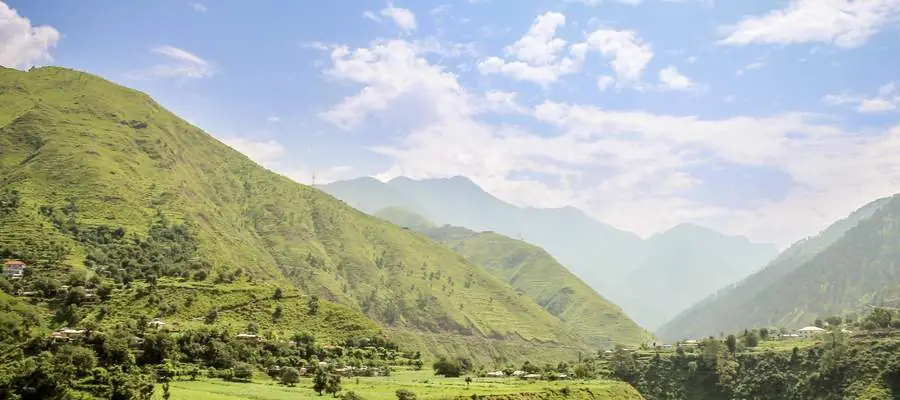
One Valley, Eight Worlds
The Kaghan Valley is not a single destination — it is 160 kilometres of them, stacked one above another along the Kunhar River from Balakot at 995 metres to Babusar Top at 4,173. Drive its length in summer and you pass through every landscape the Himalaya offers: subtropical riverside orchards, deodar and pine forest, resort plateaus, alpine lakes, treeless high meadows, and finally the snow-streaked lunar world of the pass itself. No other road trip in Pakistan compresses so much variety into a single day’s driving — which is why the valley has anchored northern tourism since the British first mapped its trout streams a century ago.
The valley belongs to Mansehra District of Khyber Pakhtunkhwa. Its spine is the N-15 road; its lifeblood is the Kunhar, born at Lulusar Lake and gathering glacier melt for 166 km before joining the Jhelum. Naran (2,409 m) is the tourism capital — the bazaar, the jeep stand, the largest hotel cluster — while Shogran, Kaghan town, Batakundi and Jalkhad each hold their own character and their own reasons to stop.
The Valley’s Greatest Hits
Lake Saif ul Malook — the fairy-tale lake at 3,224 m, reached by jeep from Naran; the valley’s icon.
Babusar Top — the 4,173 m road pass with views to Nanga Parbat; open roughly mid-June to September.
Shogran & Siri Paye — the forest plateau and its high meadows; the comfortable, romantic end of the valley.
Lulusar Lake — the valley’s largest lake, sitting right beside the Babusar road.
Lalazar Meadows — wildflower plateau facing Malika Parbat, above Batakundi.
Ansoo Lake — the tear-shaped trekking lake at 4,245 m for fit hikers.
Kunhar River — white-water rafting, trout fishing and riverside dining along the whole valley.
Balakot, Batakundi and Jalkhad — the gateway town, the quiet upper-valley base, and the camping plains: the connective tissue that makes the valley work.
How to Reach the Kaghan Valley
From Islamabad: 230 km to Naran via the Hazara Motorway (M-15) to Mansehra, then the N-15 through Balakot and Kaghan town — 5–6 hours, fully paved. From Lahore add the M-2 motorway leg for 7–9 hours total. From Karachi, fly to Islamabad and join a tour. The valley road is open to Naran from roughly April to November; the upper section past Batakundi to Babusar operates mid-June to September. Fuel is available in Balakot, Kaghan and Naran — nothing beyond. See our departure-city guides for Islamabad, Lahore, Karachi, Peshawar, Faisalabad and more.
Best Time to Visit
Late June to September is normally the broadest-access season, but no month guarantees every road or attraction. April–May is mainly for the lower valley and depends on snow clearance. Late September–October can bring autumn colour and lower demand, together with greater early-snow risk. Winter access beyond the lower valley is restricted, while Shogran trips depend on its current road. See the Naran weather guide and reconfirm official and local access shortly before travel.
How Many Days Do You Need?
2 days: Shogran and Siri Paye — the weekend classic. 3 days: Naran plus Saif ul Malook, the minimum “full valley” trip — see the 3-day packages. 4–5 days: adds Babusar Top, Lulusar and Lalazar at a humane pace — the sweet spot for families (4-day / 5-day). 7 days: combine Kaghan with Hunza, Kashmir or Swat on a grand northern circuit.
Costs at a Glance
| Item | Typical Price |
|---|---|
| Group tour packages (3 days) | from Rs. 12,500 per person |
| Day trips | from Rs. 4,500 per person |
| Hotels (per night) | Rs. 3,000–25,000 |
| Saif ul Malook jeep | Rs. 3,500–4,500 per jeep |
| Fuel Islamabad→Naran return (own car) | Rs. 12,000–16,000 |
Where to Stay in the Valley
Base yourself in Naran for the upper-valley excursions, Shogran for forest comfort, Batakundi for quiet riverside nights closer to Babusar, or Balakot for budget stopovers. Our hotel pages contain 40 listings with indicative per-night rates; availability and the final quote are reconfirmed before booking.
Distances & How It Fits Your Itinerary
| From | Distance & Time |
|---|---|
| Islamabad | 230 km to Naran · 5–6 h |
| Lahore | See Lahore departure guide for route timing |
| Naran / local | — |
First-timers should resist the checklist urge: the valley rewards one anchor sight per day. The proven rhythm is Shogran or Balakot on arrival, Naran as the two-night base for Saif ul Malook and Babusar, then Lalazar or Siri Paye on the unwinding day. Trekkers add Ansoo or Dudipatsar with a buffer day; road-trippers exit north over Babusar toward Hunza.