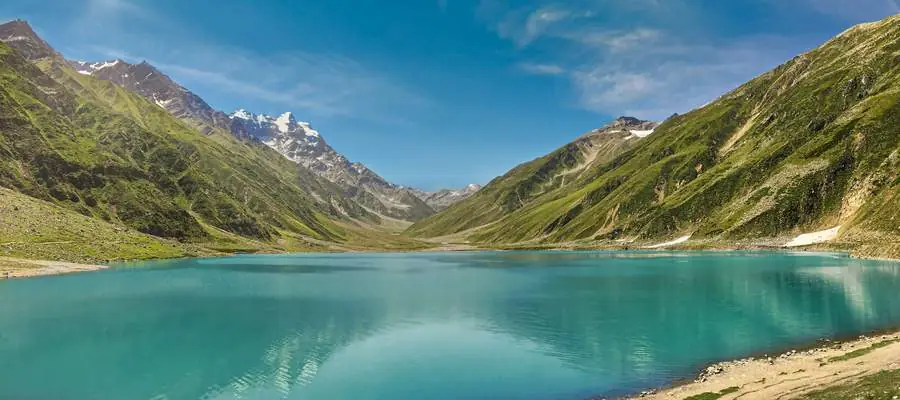
The Largest Lake in the Kaghan Valley
Forty-eight kilometres beyond Naran on the Babusar road, the valley suddenly widens and a sheet of impossibly blue water appears right beside the tarmac: Lulusar Lake, at 3,410 metres the largest natural lake in the Kaghan Valley and the true source of the Kunhar River that you have been following since Balakot. Unlike Saif ul Malook, no jeep track or hike is required — the road runs along its shore, which makes Lulusar the most effortless great view in the entire valley.
The lake is ringed by snow-streaked peaks that reflect in its surface on calm mornings, and in June and July its banks bloom with wild alpine flowers. Lulusar also carries real history: in 1857, leaders of the independence uprising fleeing British forces were captured near its shores, an episode still commemorated locally. The name derives from “Lulu” (pearl) — the pearl lake — and from certain angles the water does shine with a milky, mineral glow produced by glacial rock flour.
Things to Do at Lulusar
Shoreline photography — the classic shot is taken from the road’s small pull-offs on the western shore, with the peaks doubled in the water. Dawn and the two hours after sunrise give the calmest surface.
Short shore walks — easy, flat paths follow the lake for a kilometre in each direction. Fifteen minutes of walking leaves the roadside crowds behind entirely.
Wildflower season — late June to early August turns the surrounding meadows purple and yellow with alpine blooms; botanists rate this stretch among the richest in the valley.
Combine with Babusar and Dudipatsar — Lulusar is the natural halfway photo stop on every Babusar Top run, and the trailhead for the two-day Dudipatsar Lake trek starts at nearby Besal.
Note that swimming is dangerous and prohibited — the water is barely above freezing year-round and the lake deepens abruptly from the shore.
How to Reach Lulusar
Lulusar lies directly on the paved N-15 Naran–Babusar road, 48 km (about 1.5 hours) from Naran through Batakundi and Jalkhad. Any car that can reach Naran can reach Lulusar in season — no jeep is needed. Every Babusar Top day tour stops here in both directions, or you can hire a private car from Naran for a dedicated half-day trip. The road past Jalkhad occasionally suffers early-season snowmelt damage; from late June to September it is routinely smooth.
Best Time to Visit
The lake is accessible from roughly June to October, tied to the opening of the upper Babusar road. It remains partly frozen into early June — hauntingly beautiful, with ice sheets drifting on blue water — and fully thaws by July. For mirror reflections come before 10 AM; for wildflowers, late June to early August; for golden grass and empty shores, late September. In winter the lake freezes over completely and the road closes.
Costs and Practicalities
| Item | Typical Price |
|---|---|
| Entry fee | Free |
| Seat on a Babusar group tour (includes Lulusar stop) | from Rs. 6,500 |
| Private car from Naran (half day) | Rs. 6,000–8,000 |
| Roadside chai stalls (seasonal) | Rs. 100–250 |
Facilities are minimal: a few seasonal stalls and no formal washrooms, so plan around stops at Jalkhad or Naran.
Where to Stay
There are no hotels at the lake. Stay in Naran (1.5 h) for the widest choice, or in Batakundi (45 min) to reach Lulusar before the day-trip crowds. Campers pitch at Jalkhad’s meadows, 14 km before the lake, where summer campsites operate with basic facilities.
Distances & How It Fits Your Itinerary
| From | Distance & Time |
|---|---|
| Islamabad | 278 km · 7.5–8 h |
| Lahore | See Lahore departure guide for route timing |
| Naran / local | 48 km · 1.5 h |
Lulusar is best consumed as the anchor stop of a Babusar day rather than a standalone target — 20 unhurried minutes on the shore in each direction. Photographers who want the lake alone hire a half-day car from Naran and go early, adding Jalkhad’s braided river 14 km below for the second location. Dudipatsar trekkers stage at Besal just beyond.