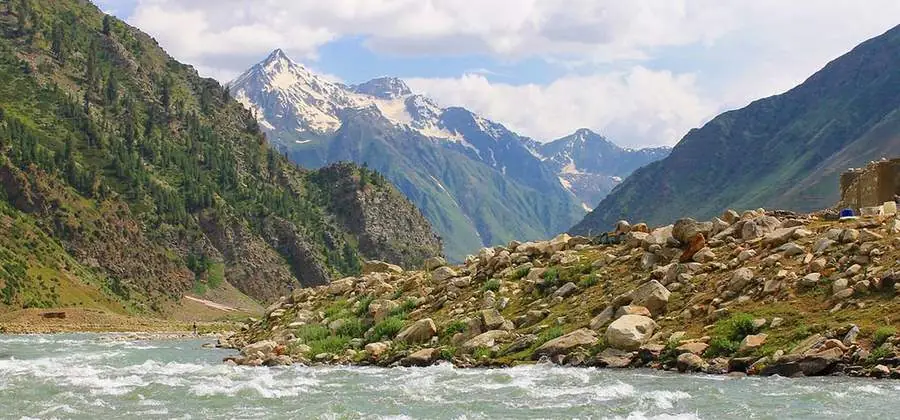
The River That Makes the Valley
Every photograph you have seen of the Kaghan Valley has the Kunhar River in it somewhere — jade-green, glacier-cold and never silent. Rising at Lulusar Lake and running 166 km down the entire valley to join the Jhelum beyond Balakot, the Kunhar is the thread on which every destination is strung: Jalkhad’s braided plains, Batakundi’s riverside hotels, Naran’s dining platforms, Kaghan town’s orchards and Balakot’s bridges. It is also the valley’s playground — Pakistan’s best-known trout fishery and one of its liveliest white-water rafting rivers.
The trout are a story in themselves: brown trout were introduced to the Kunhar in the colonial era specifically because the river’s cold, oxygen-rich water matched Scottish streams, and rainbow trout followed. A century later, “Kunhar trout” grilled fresh at a riverside dhaba is the single dish every valley visitor is told not to miss.
White-Water Rafting on the Kunhar
Rafting operates on two main stretches. The Naran section offers family-friendly rapids (roughly Grade II–III in mid-season) with 30–60 minute guided runs from about Rs. 2,000–3,500 per person including gear and safety briefing. The lower Balakot–Paras section runs bigger, longer trips for the adventurous, best in the high snowmelt of May–early July when the river is at its most muscular — Grade III–IV water that demands reputable operators and strict safety kit. By late August flows gentle out, ideal for first-timers and older children. All rafting is guided; solo boating is not permitted on tourist stretches.
Trout Fishing on the Kunhar
The fishery is permit-controlled to protect stocks: day permits (Rs. 1,500–2,500) are issued via the fisheries department office in Naran, with the season generally running April to September and certain conservation stretches closed. Prime beats include the slower water around Jalkhad, pools above Naran, and the Kaghan-town reaches. Spinning and fly-fishing both work; local guides (Rs. 2,000–3,000 per day) know the pools and handle the permit run for you. Catch limits apply — and any riverside restaurant will cook your legal catch for a small fee, which is the best possible end to the day.
Riverside Life: The Easy Way to Love the Kunhar
You do not need a paddle or a rod. The valley’s signature experience is simply eating beside the river: dining platforms at Naran, Kiwai and Batakundi seat you close enough to feel the spray, serving trout, karahi and endless chai. Add the suspension footbridges of Balakot and Kaghan town, the braided golden-hour channels at Jalkhad, and short riverside strolls from any Naran hotel — the Kunhar entertains at every energy level. One firm rule keeps it joyful: respect the water. The river is glacial and powerful; paddle only at recognised shallow edges, keep children at arm’s length near fast water, and never swim the main channel.
Costs at a Glance
| Item | Typical Price |
|---|---|
| Rafting (Naran section, guided) | Rs. 2,000–3,500 per person |
| Rafting (Balakot big-water trips) | Rs. 3,000–5,000 per person |
| Fishing permit (day) | Rs. 1,500–2,500 |
| Fishing guide (day) | Rs. 2,000–3,000 |
| Trout meal for two, riverside | Rs. 2,500–4,000 |
Where to Stay
For riverside rooms, Naran and Batakundi put the Kunhar outside your window; Balakot suits the big-water rafting base. Ask for a river-facing room — the Kunhar’s white noise is the best sleep aid in Pakistan.
Distances & How It Fits Your Itinerary
| From | Distance & Time |
|---|---|
| Islamabad | 190 km to Balakot rafting base · ~4 h |
| Lahore | See Lahore departure guide for route timing |
| Naran / local | runs the valley’s full length |
The river threads every itinerary anyway — the trick is engaging it deliberately once: a rafting morning at Balakot in early summer, a trout dinner in Kaghan town, an hour on Jalkhad’s braided flats with the kids. Rafting parties should schedule the river for the drive-up or drive-home day so wet gear never travels. And everywhere, respect the current: paddle only in the marked shallows.