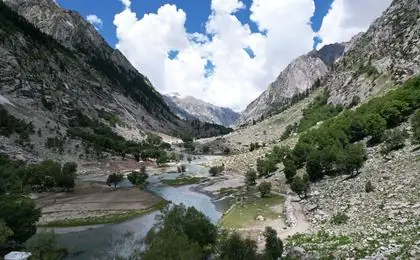
A Forest Village on the Way Up
Mahandri is a small riverside village in the Kaghan Valley, strung along the Kunhar River on the road that climbs from Balakot toward Kaghan town, roughly 40 km below Naran. Most visitors experience it exactly as generations of travellers have before them: as a wooded, cool stretch of the drive, one of a handful of villages — alongside Paras, Shinu and Jared — where the road hugs the river through dense forest before the valley opens out further up. There is no headline attraction here in the way there is at Saif ul Malook or Babusar Top; Mahandri’s appeal is quieter — shade, running water, and a slower version of the valley than the bustling stretch around Naran.
For travellers who enjoy stopping at the less-documented corners of a route rather than only its famous names, Mahandri is worth the ten-minute pause: a riverside chai stall, the sound of the Kunhar over rocks, and forest closing in on both sides of the road.
The Alternate Ansoo Lake Trail
Mahandri’s one genuine claim to fame among serious trekkers is that an alternate route to Ansoo Lake begins here — a lesser-known option to the standard Saif ul Malook approach. Documented detail on this route is thin and the difficulty is not well established in available trekking literature, which in practice means: if you’re considering it, this is an expedition for experienced, well-guided trekking parties only, not a route to attempt from general online directions. Most visitors bound for Ansoo Lake should use the standard, better-supported trail from Saif ul Malook instead; the Mahandri approach is a curiosity for specialists rather than a recommended path for typical tourists.
How to Reach Mahandri
Mahandri sits on the main Balakot–Kaghan road (the N-15), roughly 40 km before Naran on the standard route up the valley — meaning every vehicle travelling from Balakot to Kaghan town or Naran passes directly through or near it. There is no separate jeep track or detour required; it is simply one of the villages along the main road, reached the same way as Paras and Jared. Coming from Islamabad, expect to pass Mahandri roughly 4–5 hours into the drive, well before reaching Naran itself.
Best Time to Visit
Because Mahandri sits at a comparatively low altitude for the valley, the road through it is accessible for most of the year — unlike Naran and the upper valley, which shut down under snow from November to April. The forested stretch is at its greenest and coolest in June to September, and pleasantly mild in spring and autumn as well, making it one of the more reliably reachable stops on a Kaghan itinerary even in shoulder months.
What to Expect
Don’t plan a special trip around Mahandri — plan to notice it. It works best as an unhurried ten-to-twenty-minute stop on the drive between Balakot and Kaghan town: stretch your legs by the river, grab chai at a roadside stall if one is open, and enjoy a quieter, more forested stretch of the valley than the crowded viewpoints further up. Facilities are minimal and seasonal; there is no dedicated tourist infrastructure here, which is precisely the point for travellers who like discovering a valley’s ordinary villages, not just its headline sights.
Mahandri in Context: The Villages of the Lower Road
Mahandri belongs to a string of similar riverside hamlets — Paras, Shinu, Jared — that the Kaghan road threads through between Balakot and Kaghan town, each a small cluster of homes, a mosque, a few shops and the ever-present Kunhar River alongside the tarmac. This stretch of the valley is narrower and more forested than the open country around Naran, and the views are correspondingly more intimate: pine and deodar canopy overhead, glimpses of the river below, and the surrounding peaks only revealing themselves as the road gains height beyond Kaghan town. None of these villages are set up for tourism in the way Naran or Shogran are — no hotel strips, no jeep stands — and that is exactly their character. If your idea of a good travel stop includes watching ordinary valley life continue around you rather than queuing at a viewpoint, the Mahandri stretch delivers it for free, ten minutes at a time, on the way to somewhere else.
Making the Most of a Ten-Minute Stop
Mahandri rewards a specific kind of traveller: one willing to get out of the car for a village that isn’t on anyone’s must-see list. The riverside spots just off the road offer some of the valley’s most photogenic forest-and-water compositions precisely because nobody crowds them — dappled light through deodar canopy, the Kunhar running clear and fast over rounded stones, none of the jeep-stand commerce of Naran. If you’re driving yourself, simply slow down through this stretch and pull over wherever a safe shoulder appears; if you’re on a tour, mention to your guide that you’d like a short break here rather than pushing straight through — it costs ten minutes and adds a genuinely different texture to the day’s photographs than the valley’s headline viewpoints.
The Kunhar River at Mahandri
The stretch of Kunhar River running past Mahandri is narrower and faster than the braided flats further up at Jalkhad, squeezed between forested banks rather than open meadow. It is a reminder that the river you photograph calmly at Naran or fish for trout near Kaghan town began as exactly this kind of energetic, forest-hemmed stream lower down the valley. As with anywhere along the Kunhar, admire it from the bank rather than in the water — the current here is neither shallow nor gentle, whatever a calm-looking pool might suggest from the roadside.
Nearby: Paras and the Turn to Sharan
A short distance from Mahandri lies Paras, the better-known of this cluster of villages, chiefly because a side road turns off here toward Sharan — a secluded forest valley locals sometimes describe as one of the region’s quieter honeymoon retreats, well off the main tourist circuit. Neither Paras nor Sharan is set up for casual day-tripping the way Naran or Shogran are; both require planning ahead (accommodation, if any, is limited and seasonal) and suit travellers specifically seeking solitude over convenience. For most itineraries, Paras and Mahandri remain drive-through curiosities rather than overnight stops, but knowing the Sharan turn-off exists is useful if you’re the kind of traveller who likes to know what lies down the roads you’re not taking.