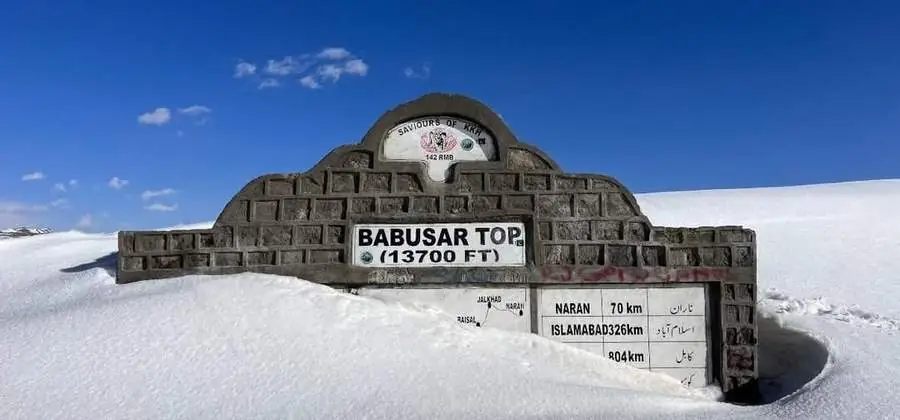
Babusar Top, also known as Babusar Pass, stands at 4,173 metres (13,691 feet) above sea level — the highest accessible point in the Kaghan Valley and the mountain pass that connects Khyber Pakhtunkhwa to Gilgit-Baltistan. For most Pakistani visitors, standing at Babusar Top is the highest they will ever be in their lives, and the experience leaves a permanent impression.
What Makes Babusar Top Special
Three things set Babusar Top apart from other mountain destinations in Kaghan Valley. First: snow. Even at the height of summer in July and August, significant snow fields remain at the summit. For families and visitors from Lahore, Karachi and other hot-weather cities, the encounter with summer snow is genuinely magical — children play in snowfields while the temperature elsewhere in Pakistan exceeds 40°C.
Second: Nanga Parbat. On exceptionally clear mornings — most common in early June and September — the silhouette of Nanga Parbat (8,126m), the world’s ninth-highest mountain and the western anchor of the Himalayan range, becomes visible on the northwestern horizon from Babusar Top. This sighting is rare enough to be memorable and extraordinary enough to be unforgettable.
Third: The gateway. Babusar Top is the point where the Kaghan Valley world — green, forested, fed by the Kunhar River — meets the stark Karakoram world to the north. Beyond the pass, the road descends to Chilas on the Karakoram Highway (KKH), and from there the entire northern Pakistan road trip opens up: Hunza, Gilgit, Skardu, the Khunjerab Pass on the Chinese border.
The Road to Babusar Top — A Guide to the Route
The roughly 66–70 km drive from Naran to Babusar Top passes through a sequence of increasingly dramatic high-altitude landscapes. The route passes Lalazar Meadows (3,100m) — flat green grasslands surrounded by cedar forest. Then Besal (3,170m) — last village with any substantial facilities. Then the remarkable Lulusar Lake (3,400m) — a glacial lake with turquoise waters and wildflower meadows. Then the long, switchbacking final climb to the broad saddle of the pass.
When Does Babusar Top Open?
Babusar Top opens only after seasonal snow clearance and authority approval. The exact date varies each year with snowfall and road work, and the pass can close again at short notice because of snow or severe weather. Check the current official road status shortly before travel rather than planning around a previous year’s opening date.
Essential Preparation Tips
Start early: Depart Naran no later than 6 AM. Clouds build up at the pass by early afternoon on most days. Dress warm: Temperature at 4,173m can be near freezing even in July. Always carry a fleece jacket, windproof layer and gloves. Mobile coverage: It can be limited or unreliable near the pass, so download offline maps before leaving Naran. Vehicle: The main road is paved when open; use a roadworthy vehicle with strong brakes and confirm any current authority restrictions before departure. Altitude precautions: Spend at least one night in Naran (2,409m) before ascending to Babusar. Altitude sickness is a real possibility when ascending rapidly from low altitudes.