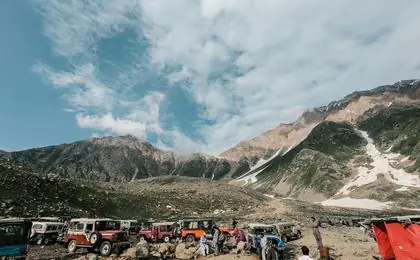
The jeep safari from Naran Bazaar to Lake Saif ul Malook is not just transport to a destination — it is an experience in itself. The 8km one-way track climbs approximately 815 metres in altitude in under an hour, through terrain that would be completely impassable for any regular vehicle. For millions of Pakistani families who have never experienced true mountain driving, this jeep ride is their most visceral encounter with the Himalayas.
The Jeep Track — What the Road is Actually Like
From Naran Bazaar jeep stand, the track initially follows the Saif ul Malook River valley northward along a rough gravel surface. Within the first kilometre, the road begins its climb in earnest — tight switchback turns cut into bare rock faces, with the valley floor dropping away to the left. The track alternates between crushed rock, bare bedrock, deep sand and, in June, occasional snow patches that require the driver to pick a careful line.
The most dramatic section comes at roughly kilometre 5, where the track crosses a narrow ledge with a sheer drop on one side and a rock overhang on the other. This section, locally known as the “death turn,” is barely wide enough for two jeeps to pass — and in peak season they regularly must. Experienced drivers manage this with practised calm, inching past oncoming vehicles with centimetres to spare. For passengers experiencing it for the first time, gripping the seat is strongly advised.
The final approach to the lake involves crossing a wide glacial outwash plain — a flat, boulder-strewn expanse of grey gravel where multiple braided stream channels from the glacier above must be forded. In early June when meltwater is high, these crossings can involve driving through fast-moving water 30–40cm deep. By August the streams have reduced and the crossing is simpler. Then, quite suddenly, the lake appears — the grey gravel gives way to green grass, then turquoise water, and the full panorama of Lake Saif ul Malook opens up in one breathtaking reveal.
Jeep Rates from Naran to Saif ul Malook
Jeep fares are seasonal and can change with demand, waiting time, track condition and local arrangements. I could not verify a current official 2026 fare schedule from a government source, so this guide does not present an old online figure as an official price. Confirm the current return fare and waiting-time terms at the Naran jeep stand or in your written tour quotation before paying.
Shared seats may be available in busy periods, while families can usually request a private jeep. Confirm the vehicle capacity, total return fare, how long the driver will wait at the lake, and whether any additional local charge applies.
Best Time to Take the Jeep Safari
5:00–5:30 AM departure from Naran Bazaar is strongly recommended. This timing gets you to the lake between 6:00–6:30 AM — during the golden hour when the sun has just risen over the eastern ridge but has not yet triggered the valley winds that disturb the famous mirror surface. The lake is at its most peaceful, the reflections are perfect, and the jeep stand queue is short.
By 8:00–9:00 AM on peak-season days, the jeep stand queue can involve 30–60 minute waits, the lake is increasingly crowded, and the mirror effect is typically already lost to wind ripples. By 10:00 AM, the peak-season lake can have hundreds of visitors simultaneously — a very different experience from the quiet pre-dawn arrival.
For photographers specifically: the best light for reflection photography is 20 minutes after sunrise to 1 hour after sunrise. Check the Naran sunrise time in your visit month (typically 5:20–5:45 AM in July) and subtract 40 minutes to calculate your ideal Naran Bazaar departure time.
The Jeep Drivers — Who They Are
The jeep drivers at Naran Bazaar jeep stand are almost exclusively local Kaghan Valley men, many from Naran town and the surrounding villages of Sattian, Battakundi and Besal. Most have been driving the Saif ul Malook track for 10–20 years. Their knowledge of the road is extraordinary — they know precisely which line to take through each boulder field, which stream crossings to avoid after rain, and when to slow to a crawl and when to commit to speed through a deep sand section.
Use an experienced local driver and a roadworthy 4×4, and confirm the operator or vehicle requirements that apply on the day. NaranTours can state the arranged driver and vehicle details in the booking confirmation, but road access and local operating rules should still be reconfirmed before departure.
What to Bring on the Jeep Safari
For the jeep ride: secure loose items in the boot, hold cameras and phones firmly (the track is bumpy enough to knock things out of hands), and wear a light windproof layer — it becomes colder rapidly as you gain altitude. For the lake: sunscreen and sunglasses are essential (UV is intense at 3,224m), warm fleece jacket for the 1–2 hours at lakeside, and at least 1.5 litres of water (no reliable source at the lake). Do not sit near the water edge on the steeper sections — the bank can be unstable.
Jeep Safari — Common Questions
Can children take the jeep? Yes — children of all ages regularly make this trip. The ride is bumpy but the vehicles are structurally safe. Infants should be held securely. Children typically find the ride thrilling. Is the track paved? No — entirely unpaved, ranging from gravel to bare rock to sand. Can regular cars do this track? Ordinary cars are not suitable for the rough lake track. Visitors normally use a local 4×4 when the track is open; confirm the current local access rule before travel. What if it rains? The track becomes significantly more dangerous in rain. NaranTours monitors weather daily and advises guests accordingly. Heavy rain = postpone the safari.